
A homeowner with a leak over the kitchen or a 20-year-old roof doesn’t ask around first. They search “roofing companies near me” or “roof repair near me,” about 139,000 and 75,000 searches a month in the U.S., and call from what they see. If your company isn’t in that first look, you’re not in the running for the estimate. That’s what roofing SEO fixes.
For most roofers, roofing SEO comes down to the right category on your Google Business Profile, a page for every service and every town you work in, steady reviews, and having all of it built before your busy season, not during it.
What Roofing SEO Is
Roofing SEO is the work of getting a roofing company’s Google Business Profile and website to show up when homeowners nearby search for roof repair, replacement or inspections, in the map pack, the organic results and AI answers. Unlike door knocking or bought leads, it brings you homeowners who are already looking for a roofer, all year.
For a roofer, that comes down to three things Google weighs: whether your profile and pages match the job searched (repair, replacement, inspections), how close you are to the homeowner, and how well known you are locally, which is mostly reviews and links. Your shop address is fixed. Your pages, reviews and links aren’t.
What Homeowners Search For
Homeowners search for the problem in front of them first and for a roofer second. These are U.S. monthly searches from Ahrefs, checked in November 2026.
| Buying searches | Monthly searches |
|---|---|
| roofing companies near me | 139,000 |
| roofers near me | 85,000 |
| roof repair near me | 75,000 |
| roofing contractors near me | 28,000 |
| roof replacement near me | 27,000 |
| emergency roof repair near me | 16,000 |
| storm damage roof repair | 14,000 |
| roof inspection near me | 12,000 |
| hail damage roof repair | 4,500 |
| commercial roofing contractors near me | 3,100 |
| Research searches | Monthly searches |
|---|---|
| roof replacement cost | 19,000 |
| roof insurance claim | 1,400 |
| does insurance cover roof replacement | 800 |
Your town is a small slice of those numbers, but the split matters. The buying searches want a roofer now. The research searches come from people a few weeks out, and the roofer who answers their question well is the one they call.
“Roofer” and “roofing company” searches are close to the same thing to Google. A November 2026 check of the map results for both in Dallas and Tampa found the top 3 shared 2 of 3 businesses in both cities. One set of pages covers both.
Which page first? I’d look at the data before guessing. If Google already shows you for searches or towns you don’t have pages for, build those first, because Google is already testing you there. Then research your market, check the competition, and work out which service makes you the most money.
Don’t skip commercial. “Commercial roofing contractors near me” gets about 3,100 searches a month, and one commercial job can pay for months of SEO, so I’d test it.
Busy Season and Storms
Roofing searches rise and fall with the seasons. In Ahrefs, “roof repair near me” went from about 26,000 searches a month in late 2024 to about 99,000 in April 2026, then dropped again in late fall and winter. In hail and hurricane markets the spikes are sharper: “hail damage roof repair” went from 489 to 9,266 between November 2024 and July 2025.
New pages take time to rank, so a page you start in the rush is often a page that ranks after it. Before your busy season, make sure you have a service area page for every area you serve. After a storm, I think Meta ads with a clear offer may get a better return than trying to rank in a week. Keep the offer about the job, not the claim: in Florida, a contractor can’t offer a gift, rebate or deductible waiver in exchange for a roof inspection or for filing a roof claim.
The other busy-season leak is the phone. When search demand jumps, so do the calls you can miss. A system that catches every call and gets the caller’s info comes before buying more leads. Google’s AI Overview for “roofing seo” makes a similar point: check that your site loads fast on a phone and that every call and form is tracked before the spike.
Competing With Storm Chasers
A homeowner on Reddit described the week after the worst hail storm in decades: dozens of roofing salesmen knocking on doors, all selling new roofs through insurance, and no easy way to tell them apart. The way homeowners sort them out is by looking each company up. Have these in place before the storm:
- Reviews that mention the town and the work, so a homeowner sees neighbors, not strangers.
- A local address on your profile and site.
- Years in business and your license number where they can see them in ten seconds.
- A storm damage page for each town you serve, with job photos from streets they’d recognize.
- Your exact Google business name on door hangers and cards, so their search lands on your profile and not a competitor’s.
You won’t out-knock a storm crew. You can be the roofer who checks out on every one of those points.
Google Business Profile for Roofers
A roofer’s primary Google Business Profile category is the most important setting on the profile, and for most roofers it’s “Roofing contractor.” Primary category is the #1 factor in Whitespark’s 2026 survey of 47 local search experts, and a wrong one is the main issue I see on contractor profiles. In that Dallas and Tampa check of “roofer” and “roofing company” searches, every one of the top 10 listings in all 4 searches used it.
Add secondary categories only for work you really do, like gutters or siding. Skip “Contractor” or “General contractor” as a catch-all; it tells Google less than “Roofing contractor” does.
- Services. List every job you want, repair, replacement, inspections, storm and hail damage, metal, flat roofs, with a description in the words homeowners search.
- Service areas. Up to 20, within about 2 hours’ drive of your base. If you’re in a big metro, list the towns around it where you can win first.
- Photos. Upload real job photos, trucks and crew for the people deciding whether to call you.
You’ll see advice, including in Google’s own AI Overview for “seo for roofers,” to upload project photos every week to rank. I’d upload them for homeowners: before and after shots of real roofs in their area win the call. In my testing, posting on the profile hasn’t moved rankings.
The Pages Your Roofing Website Needs
A roofing website needs one service page for every job you do and one service area page for every town you want work in. You will never rank for searches you don’t have content for.
- Service pages: roof repair, roof replacement, inspections, storm and hail damage, emergency leaks, and each material you install (shingle, metal, tile, flat). Commercial roofing gets its own page if you do it.
- Service area pages: one per town, with something true about that town: the neighborhoods you’ve worked in, the roof types common there, real job photos. A title like “Roof Repair in [Town] | [Your Company]” tells Google and the homeowner what the page is.
- Internal links: link to each page from your strongest pages, using the plain words people search (“roof repair in [Town]”). Your roof repair and roof replacement pages usually get the most visits, so link each town page from them.
Don’t copy one page across 30 towns and swap the name. Pages built only to funnel visitors from different cities can count as doorway abuse under Google’s spam policies.
Pages That Answer Homeowner Questions
Answer the questions homeowners ask before they call: what a roof replacement costs in your area, repair vs replace, which materials hold up in your weather, and how an insurance claim works. “Roof replacement cost” alone gets about 19,000 searches a month. Link each answer to the matching service and town pages.
Insurance claim pages are worth building only if you can help the homeowner through the claim and get it submitted. Help means documenting the damage, photos and an itemized estimate the homeowner can send in. Negotiating the claim for them is a different thing. In Florida, a contractor can’t interpret a policy or adjust a claim on the homeowner’s behalf without a public adjuster license, and ads that push roof claims have to state the deductible and insurance fraud warnings. In Texas, a contractor can’t act as a public adjuster on a property they’re working on. Check your state’s rules before you publish a claims page.
Reviews
For a roofer, reviews do two jobs: they help your local ranking, and they’re how a homeowner picks between the roofers they found.
How many do you need? In my study of 100 U.S. cities in late November 2026, the median roofer in a city’s Google Maps top 3 had 104 reviews. In the Dallas and Tampa check, the top 3 ranged from 49 to 707. Your market sets the bar.
The best moment to ask is the final walkthrough, with the new roof and a clean yard in front of them. If they don’t leave one, send the link the next day with a photo of their finished roof. Reward your crew for reviews, never the homeowner: reviews traded for a discount get removed.
Citations and Local Links
Citations are your business name, address and phone number on other sites, and they need to match everywhere. For roofers that includes the BBB, your supplier listings, and the manufacturer’s contractor finder if you’re certified with GAF or Owens Corning, since homeowners check those before they sign.
Then earn links from the people around your work: suppliers, home builders, realtors, property managers, local sponsorships, and local news. Links from real local businesses are part of how well known Google thinks you are, and they help you stand out when two roofers have the same category and similar reviews.
Lead Platforms vs Your Own Rankings
Lead platforms sell the same homeowner to several roofers, so I’d build the channels you own first and test the marketplaces after. If the same lead is going to three or four competitors, the return may not be there, even on a roof replacement.
Roofers say the same thing. An insurance-heavy roofer on Reddit listed personal network, past customers, door knocking, and Google SEO and Local Services as the quality sources, and purchased leads from Homebuddy, Networx and Angi among the ones that weren’t as good. Another roofer said they were “into this for over $11,000” after two lead gen companies. Even Google’s AI Overview for “roofing seo” warns against relying only on shared lead aggregators.
Being listed on Angi and Thumbtack for the citation is fine. Paying for their leads comes after your own profile and site are working.
AI Answers and Roofing SEO
AI answers mostly recommend roofers who already have strong local signals. In my study of 100 U.S. cities in late November 2026, the roofers recommended by ChatGPT, Google’s AI and Perplexity had a median of 127 Google reviews, against 26 for roofers in the map results that no AI named. ChatGPT named 44% of the Maps top 3 roofers and Google AI Mode named 64%. ChatGPT cited a “best of” list site in 78% of its answers about roofers.
So the work above is most of it. The rest, getting onto the lists and sites ChatGPT reads, is what AI SEO for roofers covers.
What Roofing SEO Services Should Include
Roofing SEO services should cover your Google Business Profile, a service page and a service area page for each job and town you want, reviews, citations and local links, and a monthly report on calls and form fills by source. If a roofing SEO company can’t show you what it built each month, it isn’t doing the work.
Here’s how I run it. Week one is a profile audit and fixes, a full site audit, and a backlink and citation audit, to see where you stand and find the biggest lever. You add me as a manager on your profile and you stay the owner. Each month I report on leads and where they came from, calls and form fills, plus profile activity, local rankings and AI search visibility. There’s no contract, because if someone isn’t happy working together, why keep going?
That’s what I mean by hyperlocal search: ranking in the towns you work in, for the jobs you want.
How to Judge a Roofing SEO Company
A good roofing SEO company can tell you which towns and which jobs it would go after first, and why. Ask what it would have built in the first 90 days. Ask whether you own the site and the tracking. A promise of rankings or a set number of roof leads is a red flag.
Cheap SEO usually means no real plan and no one doing the work. Someone can sound great on a call, and if they aren’t fixing or building what you need to compete in your market, it doesn’t matter. When you’re choosing a marketing agency, ask to see the pages and fixes from last month, not the slides.
One more check. Several sites ranking for “roofing seo” in Ahrefs have hundreds of linking domains but very low authority scores. Before you hire anyone, ask how they get links. If the answer is a mystery, so are the risks to your site.
What Roofing SEO Costs
Roofing SEO costs whatever it takes to compete in your market: a roofer in a small town needs less than one in a big metro. Campaigns aren’t equal and don’t cost the same, so the size of the market and the work needed to compete should set the budget. Judge a quote by what it builds and by cost per signed job, not by the monthly number alone.
If you can’t invest for 3 to 6 months, at least get your profile, your category and your roof repair and replacement pages right before your busy season. That part you can do yourself.
How Long Roofing SEO Takes
How long roofing SEO takes depends on the size of your market, the competition, and where your site starts. My goal is always to find the low hanging fruit that gets leads in fastest.
Here’s what that looks like in rankings. These are two roofing sites I built, checked from 25 points around each town.
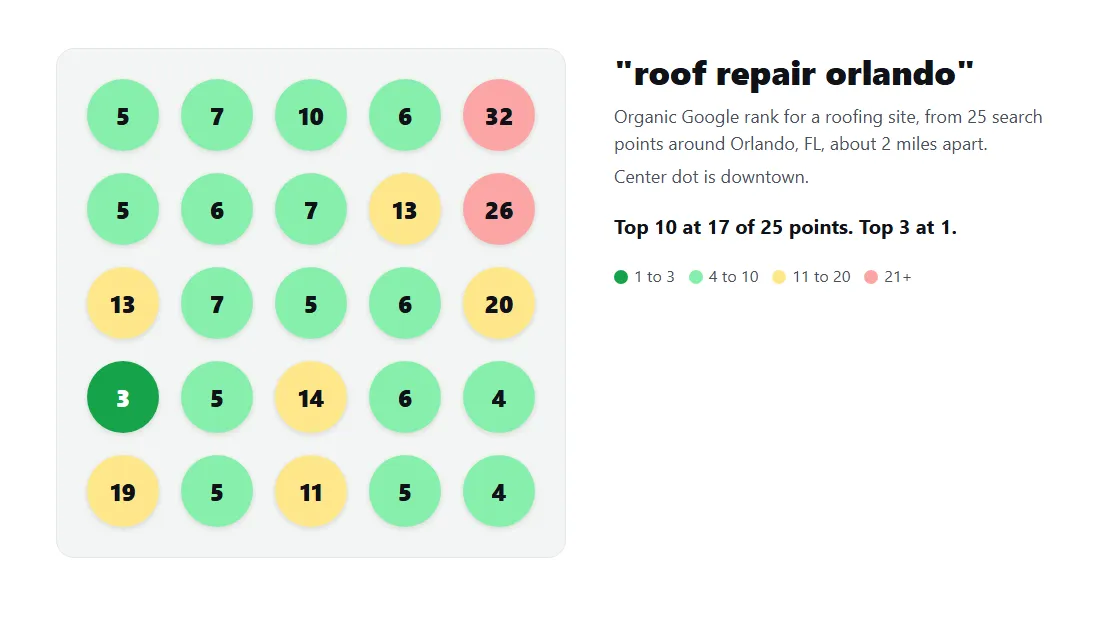
“Roof repair orlando”: the site ranks in the top 10 at 17 of 25 points, about 2 miles apart, and drops to the 20s and 30s on the northeast edge.
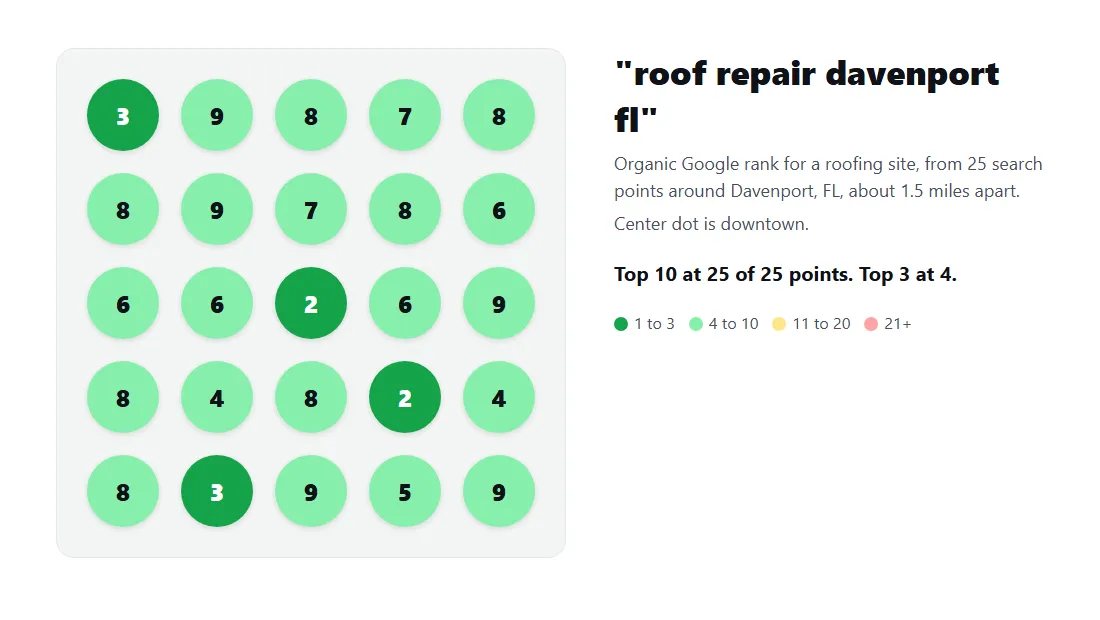
“Roof repair davenport fl”: top 10 at all 25 points, about 1.5 miles apart, and top 3 at 4. A smaller town is an easier win.
Two things stand out. Organic rank changes with where the homeowner is standing, the same way the map pack does. And the smaller town is the easier win, which is why I tell contractors near a big city to start in the pockets around it, then expand.
What to Skip
- Weekly photo uploads and posts to rank. Upload for homeowners, not for Google.
- Copy-paste town pages. One page with 30 town names swapped in can count as doorway abuse.
- Buying shared leads before your profile works. List for the citation, buy later, if ever.
- Insurance claim promises you can’t keep. Help with the paperwork. Leave the adjusting to a licensed adjuster.
- Buying AI search before the basics. The roofers AI names already have the reviews and profiles this guide covers.
What to Do This Week
Check your primary category, then count the calls you missed during your last busy month. Those two numbers tell you where roofing SEO money should go first.
Frequently Asked Questions
What is roofing SEO?
Roofing SEO is the work of getting a roofing company’s Google Business Profile and website to show up when homeowners nearby search for roof repair, replacement or inspections. It covers the map pack, the organic results and AI answers.
How much does SEO cost for a roofing company?
SEO for a roofing company costs whatever it takes to compete in your market, so a small-town roofer needs less than a roofer in a big metro. Judge a quote by what gets built each month and by cost per signed job. If you can’t invest for 3 to 6 months, start with a one-off profile audit instead.
How long does roofing SEO take?
Roofing SEO takes as long as your market, your competition and your starting point make it take. Smaller towns move faster than big metros, which is why I start in the pockets around a city. Build before your busy season so the pages are ranking when demand peaks.
Is roofing SEO or Google Ads better?
Roofing SEO and Google Ads do different jobs: ads put you at the top now while you pay per click, and SEO builds rankings that keep bringing in calls. For a roofer starting on a small budget, I’d test Local Services Ads with Google Ads first, then start SEO once the ads are running so leads come in faster.
Should roofers use Local Services Ads?
Roofers should test Local Services Ads alongside Google Ads, especially on a small budget. One roofer on Reddit said their business grew mostly through Google Business Profile, Local Services Ads, referrals and word of mouth.
Can I do roofing SEO myself?
You can do roofing SEO yourself if you have the time: set the right primary category, build a page for each service and town, ask for a review after every job, and fix your citations. If you can’t, a one-off profile audit is a cheap start.