
A high-end residential builder put it plainly on Reddit: “I’m pretty exclusively word of mouth,” and “I don’t have a marketing plan.” That’s most small custom builders. The work comes from people who already know you, and that’s fine until the referrals slow down.
Home builder marketing for a small custom builder comes down to this: keep the referrals coming, and make sure that when someone hears your name, or searches for a builder in their town, they find you and you look like the right builder. Start with your Google profile and your website. Keep referrals, realtors and lenders working. Add search. Then test paid ads, and judge every channel on signed builds, not leads.
What Home Builder Marketing Is (and Why It’s Not Like a Repair Trade)
Home builder marketing is getting the right buyers to find you, trust you and sign, across a sales cycle that can run for months. It works differently from marketing a plumber or an HVAC shop.
A repair shop runs a steady stream of small jobs. A small custom builder signs a handful, and each one is a big number. The builder north of Houston I worked with closed two builds worth roughly $400,000 to $500,000 each. Another builder on Reddit pointed out that two 2,000 square foot customs came in at $550,000 and just over $1 million, which is why you can’t quote a custom by the square foot.
A few big jobs a year change the math. One extra signed build can pay for a lot of marketing, and one bad lead source can bury you in tire kickers. There are no emergency calls, buyers take their time checking you out, and most custom builders get their work mainly by word of mouth.
Most “marketing for home builders” advice is written for production builders with communities, model homes and sales teams. This guide is for the builder doing a handful of custom or build-on-your-lot homes a year. If you sell homes in a community off a model, that’s a different playbook.
How Buyers Find a Custom Builder
Most custom buyers come from a referral or a realtor, then search Google to check you out, or search for a builder in their town. Here’s what that search looks like in the U.S., from Ahrefs data checked in November 2026:
| Search | U.S. searches a month |
|---|---|
| new construction homes near me | 16,000 |
| home builders near me | 15,000 |
| barndominium builders near me | 5,200 |
| custom home builder near me | 4,800 |
| build on your lot builders | 800 |
“New construction homes near me” is mostly people shopping production inventory. The searches a small custom builder can win are the builder, custom builder and build-on-your-lot ones.
On “custom home builder near me,” the map pack comes first, then Houzz and other directories own most of the regular results under it. The map pack, and searches with a town name in them, are where a small builder can compete.
Buyers say what they want to find, too. One person on Reddit said they look for portfolio photos and an About story, and they search “custom builders in” their town.
Even referral buyers search. Word of mouth is one of the best marketing channels, and search makes it stronger. Someone forgets the name of your company, searches “home builder” plus your city, sees your site and remembers you’re the one they heard about. You can have one or the other, but it’s better to have both.
The Channels, Ranked for a Small Custom Builder
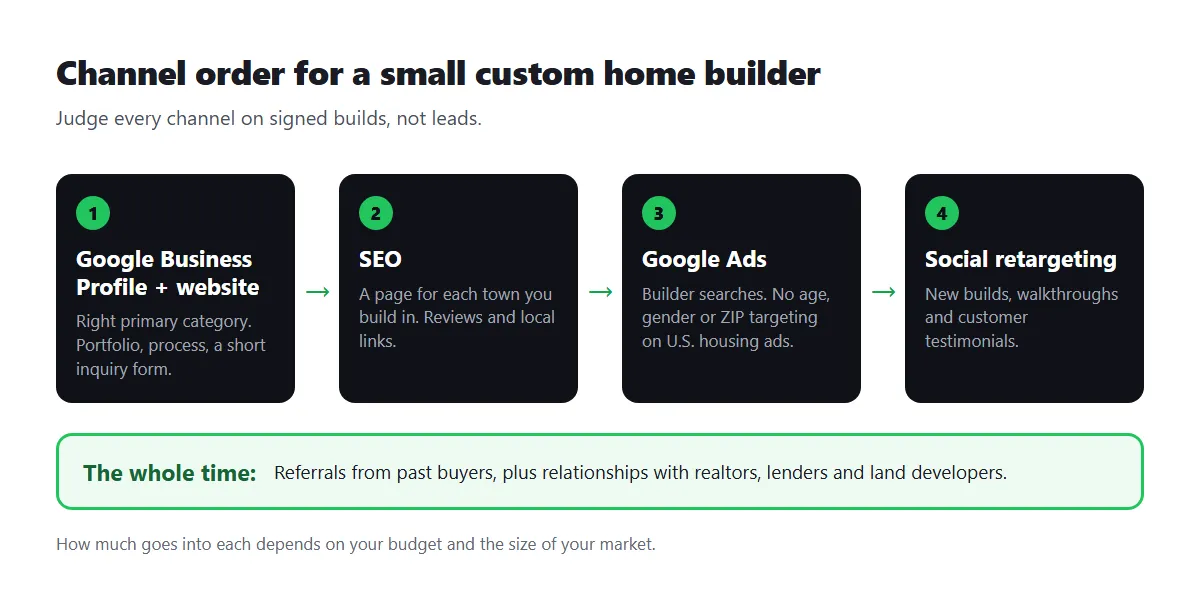
For a small custom builder, the order I’d work in is: your profile and website first, referrals and partners always, SEO next, then paid ads. How much you spend on each depends on your budget and the size of your market.
| Channel | What it does for a builder | Rough cost | How fast | Judge it by |
|---|---|---|---|---|
| Google Business Profile | Shows you in the map pack and when people search your name | Free, plus your time | Weeks | Calls, website clicks, direction requests |
| Website and portfolio | Where every referral and search ends up | One-time build, plus upkeep | Before anything else | Inquiries |
| Referrals, realtors, lenders | Your best leads | Time and thank-yous | Ongoing | Signed builds by source |
| SEO | Builds your own lead flow from search | Monthly | Depends on your market | Inquiries from search |
| Google Ads | Puts you in front of high-intent searches now | Ad spend plus management | Days | Cost per signed build |
| Facebook and Instagram | Shows the work and keeps you in front of people who’ve seen you | Ad spend | Days | Qualified inquiries, not likes |
| Paid listings (Houzz Pro, lead platforms) | Rented visibility | Monthly fees | Varies | Usually skip |
The costs are ranges on purpose. The size of your market and the work it takes to compete should set the budget.
Start With Your Google Business Profile
Your Google Business Profile is free, it’s what shows up when someone searches your name or a builder near them, and the primary category is where most builders go wrong. Wrong primary category is the main issue I see on contractor profiles. It’s also the number one local pack factor in Whitespark’s 2026 Local Search Ranking Factors survey.
The builder north of Houston had their primary category set to plain “Contractor.” I changed it to “Custom home builder,” optimized the rest of the profile, built citations and did link building, along with the website work. The profile got into the top 3 of the map pack, and the builder closed two home builds worth roughly $400,000 to $500,000 each, probably within 6 months of the work.
A few rules builders trip on. A model home or a home you’re selling can’t have its own profile, but a sales office can be verified. Add photos of finished homes, list your services, and keep reviews coming from past buyers. In BrightLocal’s 2026 consumer survey, 31% of people said they’ll only use a business with 4.5 stars or better.
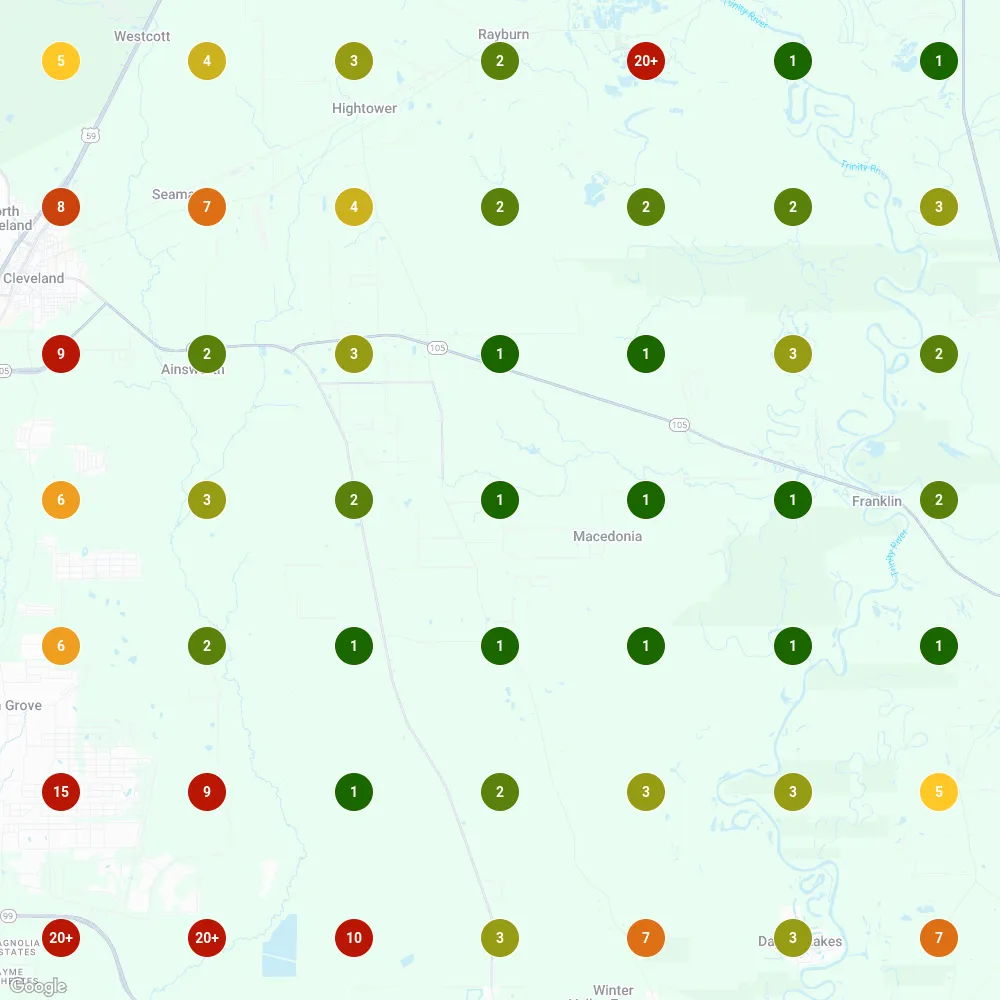
That’s the same builder a few weeks after the category fix and the rest of the work, top 3 across most of the grid for the main search.
A Website That Sells a $500,000 Build
A home builder’s website has to make a buyer feel safe handing you a six-figure check. That means real projects, your process, who you are, and an easy way to start.
What I’d put on it:
- A portfolio with real photos for each project. Note the town, the style and the size.
- An About page with your story. That’s one of the first things buyers say they look for.
- Your process from lot to keys, so a first-time builder knows what happens when.
- Build-on-your-lot information, if you do it.
- A short inquiry form that asks for the timeline, whether they own a lot, and a budget range. That’s how you sort a $1 million build from a $150,000 remodel before you drive out.
- A page for each town you build in, with something true about that town. The full how-to is in home builder SEO.
And own it. If someone builds your site, ask whether you’ll own the site and its files, and whether you’ll own the tracking and ad accounts. I built my business on that rule after an HVAC contractor’s old agency kept his website when he fired them.
SEO: Get Found in the Towns You Build
Home builder SEO is how a builder shows up in the map pack and for “custom home builder in [your town]” without paying for every click. For a builder, it’s the right primary category, a page for every town you build in, steady reviews from past buyers, and local links.
For the builder north of Houston, “custom home builder” went from the top 3 at 6 of 49 grid points on a 10-mile grid before the work to 32 of 49 on a slightly tighter 9-mile grid after. That’s what I mean by hyperlocal search: ranking in the towns you build in, for the jobs you want.
If you’re in or near a big metro, start in the towns outside it, where you can rank faster, then expand. How long SEO takes depends on the size of the market, the competition and where your site is now.
Google Ads and Local Services Ads for Home Builders
Google Ads can put you in front of buyers searching today, and the clicks are cheap compared with most trades. Local Services Ads don’t have a home builder category.
Ahrefs estimates clicks on builder searches at about $0.30 to $3.00. Cheap clicks don’t mean cheap leads, though. You sign a few jobs a year, so the only number that matters is what you paid per signed build.
Google’s housing ad rules matter here. In the U.S., you can’t target housing ads by age, gender, marital status or parental status, or by ZIP code. Target by the search terms and by city or radius instead.
Local Services Ads are only available for certain categories. The U.S. list has General contractor and remodeling categories, but no home builder. If someone tries to sell you LSA as a builder, have them check Google’s eligibility tool for your area first.
In the order I’d go, Google Ads comes after the SEO basics are done: the profile optimized and service pages built for the areas you serve.
Facebook and Instagram for Home Builders
Facebook and Instagram are where a home builder shows the work and stays in front of buyers during a long decision. Housing ads come with targeting limits there too.
Meta counts ads for homes for sale as housing ads. Under its housing Special Ad Category, targeting by age, gender and ZIP code, exclusions, lookalike audiences and saved audiences are limited or not available, and city or pin-drop audiences get an expanded radius. A “we build on your lot” ad isn’t clearly covered by Meta’s examples, which Meta says “aren’t comprehensive,” so when in doubt choose the category. Get it wrong and the ad can be rejected.
I would still run Facebook and Instagram ads, targeting the service area with new home builds, walkthroughs and customer testimonials. A new home is one of the biggest purchases someone will make, so show them as much as you can: results, quality and customer reviews. I’ve run profitable Meta campaigns that turned cold audiences into buyers.
Watch the offer, though. One builder’s Facebook and Instagram campaigns brought in “a TON of renovation leads” in the $100,000 to $300,000 range, when the company was moving to $1 million-plus home builds. The ad and the form have to say what you build.
Referrals, Realtors and Lenders
Referrals are still the best leads a custom builder gets. The job is to make them easier to give and easier to act on.
The usual advice from builders on Reddit is to network with realtors and land developers. An employee of a large developer, about 650 homes a year, called realtors “your best friends” and credited outreach to realtors and model visitors with about 40% of their sales. That’s a big company, but the point carries down to a small one.
Good relationships with lenders, agents and land developers are worth working, the developers especially if you don’t do land development yourself. Make it easy for them: a build-on-your-lot page they can send, and reviews from past buyers on Google. Ask past buyers for referrals when you hand over the keys.
Houzz, Parade of Homes and Paid Listings
Houzz, Parade of Homes and similar listings are worth it only where they’re free. There’s no sense in paying recurring monthly fees to be listed on Houzz, Parade of Homes or the local home builders association. There are plenty of other link opportunities at much better rates.
A free Houzz profile still has value, because Houzz owns the top regular result for “custom home builder near me.” The paid side is a different story. One contractor on Reddit paid $400 a month for a year of Houzz Pro, got 35 clicks or referrals, and says Google sent over 3,500 people in the same period. The plan also auto-renewed without warning.
The same goes for lead platforms. Be listed for the citation, but put your money into SEO and Google Ads before you buy leads there.
Follow Up for a Sales Cycle That Takes Months
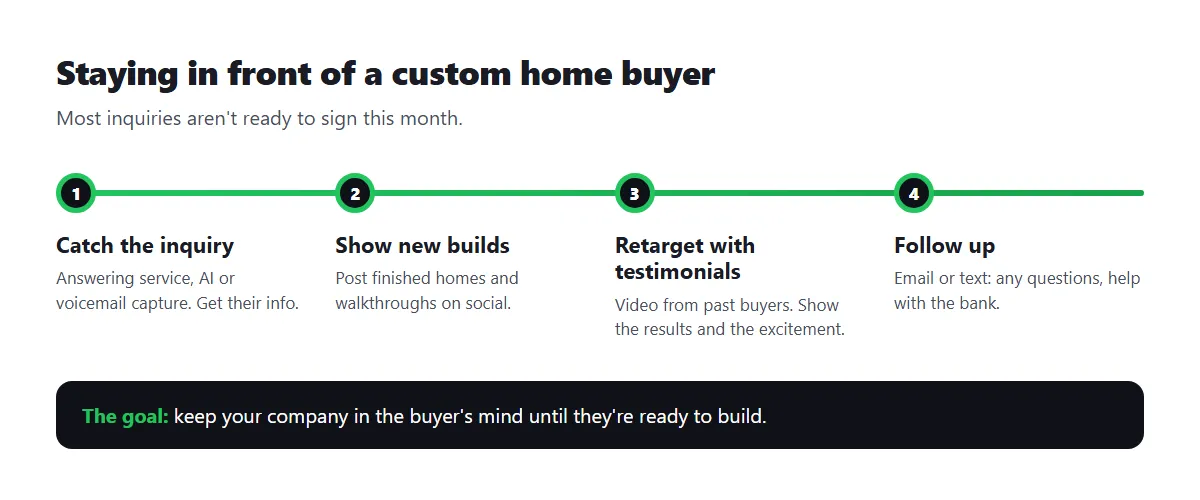
Most home builder inquiries aren’t ready to sign this month. The money is in catching every inquiry and staying in front of the buyer until they are.
Catch the call first. You’re on a job site when the phone rings, so look at an answering service, or AI or voicemail that captures the call. A system to catch the call and get the caller’s info should come before more leads.
Then stay in their mind. Post your new builds on social, get video testimonials from past buyers, and run retargeting ads with them. Show the results and the excitement of your clients. Who isn’t excited moving into a new custom built home? Capture that, and get your company mentioned. Then follow up by email or text: any questions, help with the bank.
Track Cost per Signed Build, Not Cost per Lead
Cost per signed build is what a channel costs divided by the builds it signs. Leads and clicks are only the steps in between.
Here’s how the math works, with made-up round numbers. Say a channel costs $2,000 a month. Over 12 months that’s $24,000. If it brings 40 inquiries and you sign one build, that build cost $24,000 to win. If your margin on that build is far more than $24,000, the channel works, even though $600 per inquiry sounds awful. A channel with $50 leads that never signs a build is the one losing money.
To know which channel signed the build, use more than one method:
- A form question that asks how they heard about you.
- Call tracking, so you know which calls came from which channel.
- Form tracking that passes the lead’s source along with the form.
Ask again on the first call, because a buyer who found you on Google after a realtor mentioned you may say either one.
What a Home Builder Marketing Agency Should Do
A good home builder marketing agency fixes the profile, builds the pages, reports which channel each lead came from, and you own everything.
In my first week with a new client, I audit and fix the Google Business Profile, audit the whole site, and audit backlinks and citations, to see where they stand and find the biggest lever to pull. Each month I report leads and where they came from, plus profile activity, local rankings and AI search visibility.
Before you hire anyone, ask four things: do I own the site and its files, do I own the tracking and ad accounts, is there a contract, and what do you guarantee? A promise of rankings or a lead count is a red flag. I don’t do contracts. If someone isn’t happy working together, why keep going? More on choosing a marketing agency before you sign.
Cheap usually means no real strategy behind it. Someone can sound great on a call, but if they aren’t fixing or building what’s needed to compete in your market, it doesn’t matter.
What to Skip
- Monthly fees to be listed. Houzz Pro, paid association listings and similar.
- Production-builder tactics you don’t need yet. Virtual design centers, community plans, model home traffic programs.
- Buying leads before your own profile and site work.
- Social ads judged on likes. Judge them on qualified inquiries and signed builds.
- Ads that attract the wrong job. If remodel leads show up when you want builds, fix the ad and the form.
One Thing to Do This Week
Check your Google Business Profile’s primary category. Then add your last five finished homes to the profile and the website, with the town name on each, and ask your last three buyers for a Google review.
Frequently Asked Questions
How do you advertise as a home builder?
Start with referrals, your Google Business Profile and your website, because every other channel sends people there. Then run Google Ads on builder searches, within the housing ad rules that bar targeting by age, gender or ZIP code in the U.S. Use Facebook and Instagram to show the work and retarget people who’ve seen you.
How much should a home builder spend on marketing?
It depends on your budget and the size of your market. Work backward from what one signed build is worth to you, and track cost per signed build for each channel.
Do Local Services Ads work for home builders?
Not as a home builder. Google’s U.S. list of Local Services Ads categories has General contractor and remodeling categories, but no home builder category. Check Google’s eligibility tool for your area.
Is Facebook good for marketing custom homes?
For showing new builds, walkthroughs and testimonials, and for retargeting, yes. Ads for homes for sale fall under Meta’s housing Special Ad Category, which limits age, gender and ZIP targeting. Make the ad say what you build, or you may get remodel leads instead.
Is Houzz worth it for home builders?
A free profile, yes. Paying recurring monthly fees to be listed, no. One contractor paid $400 a month for a year of Houzz Pro and got 35 clicks or referrals.
Do I need a home builder marketing agency?
Not if you can fix your profile, keep your site current and work your referrals yourself. If you hire one, ask who owns the site and accounts, whether there’s a contract, and what they guarantee.