
An HVAC contractor I worked with was paying a big, well-known agency $5,000 a month. Six months in, he had no leads to show for it. When he finally fired them, they kept his website and every file he’d paid them to build.
So I rebuilt it. That took a few weeks. Within the first month he was in the map pack, ranking #1 for HVAC repair and AC repair around his shop. In his words, the phone “finally started ringing.”
None of it was magic. HVAC SEO mostly comes down to one thing: getting into the three map spots when someone near you searches for AC repair or a furnace guy. Three moves decide most of that. The right primary category on your Google Business Profile, a complete profile with a steady stream of reviews, and a website that backs up what the profile says. Below is everything I’d do, in the order I’d do it, plus how to judge anyone you pay to do it.
What HVAC SEO Is
HVAC SEO is getting your heating and air business to show up in Google’s map pack, and in the local results under it, when someone near you searches for the work you do. It covers your Google Business Profile, your website pages, reviews, citations and local links.
It’s not the same as Google Ads or Local Services Ads. You don’t pay per click for a map spot, and there’s no way to pay Google for a better local ranking. That matters if you’re up against the private equity backed shops in your area. Owners in that spot tell each other you will never outspend the big guys on ads. You don’t have to. They can’t buy the map spot around your shop either.
It’s the same plan I lay out for plumbers and electricians. HVAC has a few twists of its own: seasons, maintenance plans and bigger competitors.
What Homeowners Search For
Homeowners search for the problem in front of them, and the map pack is where those searches land. Ahrefs data from October 2026 for the U.S.:
| Search | Searches a month (U.S.) |
|---|---|
| furnace repair near me | 129,000 |
| AC repair near me | 103,000 |
| HVAC repair near me | 95,000 |
| AC installation near me | 43,000 |
| HVAC contractor near me | 11,000 |
| heat pump installation near me | 7,300 |
Every one of them shows a map pack at the top. Your town is a small slice of those numbers, but one “Services” page can’t be the best answer to all six.
So which page do you build first? I’d look at the data you already have. Open Google Search Console and check whether Google is already showing your site for services or towns you don’t have a page for. Those are usually the quickest wins, because Google is already putting you in front of those searches. Then build the pages you’re missing. After that, prioritize by the work that makes you the most money in the area you can win, not by the biggest search number.
How Google Decides Who Gets the Map Spots
Google bases local results on three things: relevance, distance and popularity. Relevance is how well your profile matches the search. Distance is how far you are from the person searching. Popularity, which Google’s help page also calls prominence, is how well known you are, including the links and reviews pointing at you.
That’s Google’s version. The more useful one comes from the people who test this for a living. Whitespark’s 2026 Local Search Ranking Factors report had 47 local SEO experts score 187 ranking factors. Their top six for the map pack:
- Primary Google Business Profile category
- How close your address is to the searcher
- Keywords in your business name
- A physical address in the city being searched
- Being open when someone searches
- A high star rating
Notice what’s at #2. Proximity is the one you can’t fake. You win around your shop first, then you push out from there.
This is what it looked like for the HVAC contractor above: a scan for “HVAC contractor” from May 2023, on a 3 by 3 grid of search points 1 mile apart, centered on his shop.
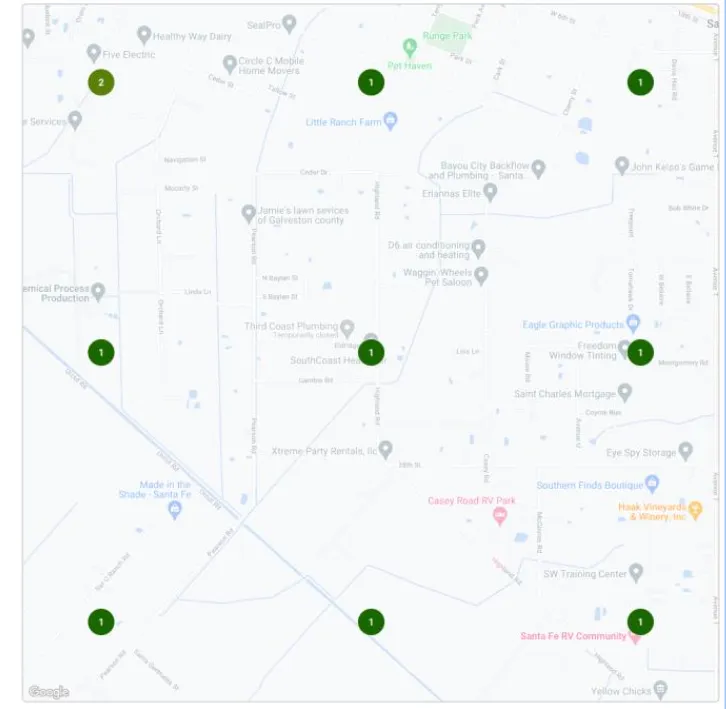
Each dot is a search from that spot. He was #1 at 8 of the 9 points and #2 at the other. The same day, he averaged position 1.44 for “AC repair” and for “AC installation”, and 1.78 for “air duct cleaning service”. Read a grid like a weather map. Green near your shop is the baseline. The work is turning the edges green.
Fix Your Primary Category First
Your primary category is the most important setting on your whole Google Business Profile. It’s #1 in Whitespark’s 2026 survey, ahead of proximity and reviews. It’s also the most common mistake I see when I open a contractor’s profile.
Google’s rule is to pick as few categories as you can, as specific as you can, and to finish the sentence “this business IS a” rather than “this business HAS a.” For HVAC that usually means one of these as your primary:
- HVAC contractor
- Air conditioning contractor
- Heating contractor
- Air conditioning repair service
- Furnace repair service
Pick the one that matches the search you most want to win. Then add secondary categories only for work you do. You get up to 9 extra, and they rank #8 on the expert list.
How much does the category matter? A home builder I worked with had their primary category set to plain “Contractor.” I changed it to “Custom home builder,” built out the rest of the profile, and they got into the top 3. The builder closed two home builds, worth roughly $400,000 to $500,000 each. Different trade, same lesson. Google can’t show you for a search it doesn’t think you belong in.
Plan for the Seasons
HVAC has a trick most trades don’t. Switch your primary category with the season: “Air conditioning contractor” in the summer, “Heating contractor” in the winter. It makes sense to capitalize on the season.
Spring and fall are where most shops go quiet, and that’s when I’d get ready for the next rush. Make sure your seasonal pages, the AC tune-up and furnace tune-up pages, are on the site and optimized before the weather turns. This is also a good time to run social ads promoting a maintenance offer. The weather is coming when nobody wants to go without A/C or heat, so it’s a perfect time for service.
Finish the Rest of Your Google Business Profile
After the category, fill in everything else: your services, your hours, your service area and real photos. It’s boring, and it works.
Services. Your category comes with suggested services, and you can add your own with a description for each. List every job you want to be found for, in the words homeowners use.
Hours. “Open at the time of search” is the #5 factor on the expert list. Set your holiday hours so you don’t show as closed when the AC dies on July 4th. Only list 24/7 if somebody answers at 2am.
Address. If customers don’t come to your shop, hide your address and set a service area instead. The catch is that a visible address ranks better. It’s #7 on the expert list. So if you have a real shop or office customers can walk into, show it. If you work out of your house, hide it and live with that tradeoff. What you never do is rent a virtual office or a mailbox to get a better address. Those aren’t eligible for a profile at all.
Service area. You can list up to 20 service areas, and the whole area should stay within about 2 hours’ drive of where you’re based. In practice you’ll rank much closer to home than that anyway.
Q&A. If someone tells you to load up your Q&A section, that advice is out of date. Google removed Q&A from Maps starting in December 2025 and replaced it with AI answers that pull from your profile and your reviews. The best thing you can do for those answers is keep your profile accurate.
Your Business Name: What Google Says vs. What the Data Shows
Google’s rule is simple: your Google Business Profile name has to be your real-world business name, with nothing extra added. Putting service or location words in the name can get the profile suspended.
The data says something different. Keywords in the business name are the #3 factor in Whitespark’s survey. Whitespark also studied business names in 2026 and found names with keywords in them showed up in the top 3 more often in most industries.
Both things are true. Stuffing “Best AC Repair Houston” onto your profile breaks the rules, and Google can strip those words out and take the ranking boost with them. The legit route is a real name change. If you’re rebranding or filing a DBA anyway, putting “Heating & Air” in it is fair game.
Would I tell an HVAC owner to do it? It does help. But I’m seeing profiles get harder to verify, and that’s the risk you take on. It’s a risk versus reward call, and it comes down to your market and how stiff the competition is.
Reviews: What Moves Rankings and Calls
You want a high star rating and a steady flow of reviews with real text in them. More reviews and better ratings can help your ranking, one of the few factors Google confirms, and the expert list has rating at #6 and review count at #9.
Reviews count for even more when people decide who to call. BrightLocal’s 2026 survey of 1,002 U.S. consumers found 97% read reviews for local businesses. 31% said they’ll only use a business with 4.5 stars or better, up from 17%.
To be fair about the HVAC contractor’s results: he already had 320 reviews and a 4.9 rating before I started. That’s a big part of why the fixes worked so fast. If you’re sitting at 20 reviews, this is the first thing to work on.
The process I give HVAC owners:
- The tech asks on the spot. When the job’s done and the customer is happy, that’s the moment.
- Text a follow-up 24 hours later if they didn’t leave one then. Send the direct review link so it’s one tap.
- Reward your techs for every review. It keeps them asking.
Reward the tech, never the customer. Google removes reviews that were paid for or given in exchange for a discount. It also bans only asking your happy customers and pressuring people into leaving one. Ask everybody, the same way, every time.
Then reply to every review, good and bad. In BrightLocal’s survey, 89% of consumers expect an owner to respond. Keep it short and use their name.
Make Your Website Back Up the Profile
Your profile tells Google what you are. Your website has to agree with it.
For the HVAC contractor, the website work was simple. I reworked the home page around the main money search and added internal links with plain, direct anchor text pointing at it. It’s the same pattern I used when I got a law firm to #1 for “Orange County personal injury lawyer,” one of the most competitive legal searches in California.
The setup I’d build for an HVAC shop:
- One page per main service. AC repair, AC installation, furnace repair, heat pumps, duct cleaning, maintenance plans. Each one with the service and your area in the title and the first heading.
- Link to them from your strongest pages. Your home page and whatever pages get the most traffic and links. Use plain anchor text like “AC repair,” not “click here.”
- Service area pages for the towns you serve. Each one needs something true about that town: the neighborhoods you work in, the jobs you’ve done there, what’s different about the homes.
- A site that works on a phone. When I built a new site for an electrical contractor, the old one wasn’t mobile friendly and had no service area pages for the towns he worked in. His leads went up after the new site.
Don’t skip the town details. Copying one page across 30 cities and swapping the town name is what Google calls doorway abuse, and it’s against its spam policies. You’ll see agencies say each city page needs 1,500 unique words. That number shows up on agency blogs with no source behind it. Write what’s useful for someone in that town and stop.
One more thing about your website: make sure it’s yours. The domain, the hosting login and your Google Business Profile should all be in your name. That HVAC contractor learned that the expensive way.
Citations and Local Links
Citations and local links for an HVAC shop come down to two jobs: get your business name, address and phone number exactly the same everywhere you’re listed, then earn a few local links.
Citations first. That means Google, Bing Places, Apple Business Connect, Yelp, Facebook and the BBB, plus the trade directories. I’d also list on Angi and Thumbtack for the citation, but I’d put money into SEO and Google Ads before I’d pay for their leads. When I handled citations for 18 law firms, that meant accuracy audits and duplicate cleanup. It’s tedious, and it pays off.
Links next. You don’t need hundreds. The ones HVAC shops can get:
- The dealer locator on your equipment manufacturer’s site
- Your supply house, if they list contractors
- Local sponsorships: Little League, school events, the 5K
- Your chamber of commerce
If you want a bigger link, publish something local people want to cite. I once built a statistics page on dog bites for a personal injury firm. It earned links from 127 different websites. For HVAC, think local data: heat waves, the most common AC failures you see, what a new system really costs in your area.
Answer the Phone Before You Buy More Calls
Before you pay for more leads, count the calls you’re already missing. A system that catches the call and gets the caller’s info should come before getting more leads.
If your techs are on a roof in July and the office line rings out, look at an answering service, or AI or voicemail that captures the call. One HVAC owner on Reddit put the frustration plainly: “constantly paying to compete with the same companies over the same customers.” More rankings won’t fix that if half the calls go to voicemail and never get returned.
Competing With the Big Shops
The private equity backed shops with big ad budgets are beatable in the map pack. The PE sites don’t always have the best SEO, so there can be an opportunity to beat them. And they can’t pay Google for a better local ranking any more than you can.
Start with geography. Where is their shop compared to yours? Proximity is the #2 factor in Whitespark’s survey, so look for the pockets of town you’re closer to. Win the rankings there, then the leads.
The same goes for big metros. A young company in Houston is going to have a tough time competing across the whole city, but pockets outside it, like Kingwood, Tomball, Cypress or Conroe, can bring faster rankings and more leads before you expand. That’s where hyperlocal search starts: win the searches closest to your shop first, then push out.
What HVAC SEO Services Should Include
HVAC SEO services should cover the work above and report on it every month. When you’re choosing a marketing agency, look for:
- An audit first. Your profile, your website, and your links and citations, so the work starts with the biggest lever.
- Real work, not just ideas. Talk is cheap. Someone can sound great on a call, but if they aren’t fixing or building what’s needed to compete in your market, it doesn’t matter.
- A report that starts with leads. Calls and form fills and where they came from, then profile activity, local rankings and how you show up in AI search. That’s how I report to clients.
- No long contract. I don’t do contracts. If someone isn’t happy working together, why keep going?
- Everything in your name. When I take on a contractor, they add me as a manager on their profile and stay the owner.
That’s what I mean by hyperlocal search: ranking in the towns you serve, for the jobs you want.
How to Judge an HVAC SEO Company
The best way to judge an HVAC SEO company is to take the buzzwords off the proposal and ask what’s being built. “Local pack visibility” and “authority building” are fancy ways of saying optimize your Google Business Profile and build links. They should turn into a list: which profile fixes, which pages, which links.
Then do the math on your own jobs. Take your average ticket and work out how many extra booked jobs a month it takes to cover the fee. A maintenance agreement or a system replacement changes that math a lot, so use your own numbers.
Four questions to ask on the first call:
- If you build my site, do I own the site and its files?
- Do I own the tracking and ad accounts?
- Is there a contract?
- What do you guarantee? A promise of rankings or lead counts is a red flag.
Watch the timeline answer too. One commenter in an HVAC owners’ thread warned that an agency quoting “X months” can use it as an excuse for not producing. Some markets do take longer. But you should see work done every month, even before the phone picks up.
How Long HVAC SEO Takes
How long HVAC SEO takes depends on the size of your market, the competition, and where your site and profile are now. My goal is always to find the low hanging fruit that gets leads in fastest.
The HVAC contractor in this guide was in the map pack within the first month after his rebuild. He also already had 320 reviews, which sped things up a lot. A new shop with 15 reviews in a big metro is a different job.
If you can’t commit to investing for 3 to 6 months, hold off on a full campaign. A one-off Google Business Profile audit and optimization is the better buy until you can, or learn it yourself from YouTube.
What to Skip
A lot of local SEO advice is busywork. This is what I’d skip.
Posting on your profile to rank. It’s the most common “do this weekly” advice out there. In the expert survey, post frequency ranks 148th out of 187 factors. In my own testing I haven’t seen posts move rankings. They can help Google crawl your pages, and you can automate them, so they don’t hurt. Don’t pay someone to do them for rankings.
Seeding your Q&A. That feature’s gone.
Geo-tagged photos. Dead last in the survey, 187th of 187. Upload real photos of real jobs because they help people pick you, not because of what’s in the file data.
Cloned city pages and virtual offices. One is against Google’s spam policies, the other gets your profile pulled.
Buying AI search before the basics. AI search matters, and the longer you wait the harder it gets, but part of it is good SEO foundations. Google’s AI answers in Maps already pull from your profile and reviews. Get those right first.
How to Tell It’s Working
Track two things: where you rank around your shop, and how many booked jobs you get from it.
For rankings, run a grid scan like the one above once a month for your top 3 searches. That’s how I measured the HVAC contractor’s results. It shows you exactly where you’re green and where you’re not, which beats one rank number from a tool that searched from who knows where.
For calls, look at the calls and website clicks in your Google Business Profile, then count booked jobs. Rankings are a means to an end. Booked jobs are the number to watch.
If you do one thing this week, open your profile and check your primary category. Make sure it’s the most specific one that matches the search you most want to win. Then run one grid scan around your shop so you know where you’re starting from. The whole order of operations for any trade is the same one in SEO for contractors: profile, then pages, then reviews and links.
Frequently Asked Questions
What is HVAC SEO?
HVAC SEO is getting a heating and air business to show up on Google, in the map pack and local results, when people nearby search for HVAC work. It covers your Google Business Profile, your website pages, reviews, citations and local links.
How does HVAC SEO work?
Google ranks local results on relevance, distance and popularity. You make your profile and website match the searches you want (relevance), win the area around your shop first (distance), and build reviews and local links (popularity). The primary category is the biggest single setting.
How much does HVAC SEO cost?
It varies too much by market for one honest number. The size of your market and the work it takes to compete should set the budget. What matters more is what you get for it: work you can see every month, no long contract, and everything (your site, your domain, your profile) in your name.
Should I change my Google Business Profile category for summer and winter?
For HVAC, yes. Run “Air conditioning contractor” as your primary in the summer and “Heating contractor” in the winter. Capitalize on the season.
Do Google Business Profile posts help rankings?
Not much. Post frequency ranks 148th of 187 factors in Whitespark’s 2026 survey, and I haven’t seen posts move rankings in my own testing. They’re low effort and don’t hurt, so automate them if you like.
Is SEO still worth it for HVAC companies?
Yes. Every big HVAC search, from “AC repair near me” to “furnace repair near me,” still shows a map pack. AI answers in Maps now pull from your profile and reviews too. The longer you wait to build that up, the harder it gets.
Do I need SEO if I run Local Services Ads?
Yes, if you want the map pack. Ads don’t change where you rank in it, because Google doesn’t sell local rankings. When you pause the ads, the map pack is what’s left.