
An HVAC contractor I worked with was paying a big, well-known agency $5,000 a month. Six months in, he had no leads to show for it. When he finally fired them, they kept his website and every file he’d paid them to build.
So I rebuilt it. That took a few weeks. Within the first month he was in the map pack, ranking #1 for HVAC repair and AC repair around his shop. In his words, the phone “finally started ringing.”
None of it was magic. For an HVAC contractor, local SEO mostly comes down to one thing: getting into the three map spots when someone near you searches for AC repair or a furnace guy. Three moves decide most of that. The right primary category on your Google Business Profile, a complete profile with a steady stream of reviews, and a website that backs up what the profile says. Below is everything I’d do, in the order I’d do it.
What Local SEO for HVAC Contractors Is
Local SEO for HVAC contractors means showing up in Google’s map pack, and in the local results under it, when someone near you searches for the work you do.
That map pack is where the money searches land. According to Ahrefs, “furnace repair near me” gets about 129,000 searches a month in the U.S. “AC repair near me” gets about 103,000. “HVAC repair near me” gets about 95,000. Every one of them shows a map pack at the top.
It’s not the same as Google Ads or Local Services Ads. You don’t pay per click or per lead for a map spot, and Google says there’s no way to pay for a better local ranking. That matters if you’re up against the private equity backed shops in your area. Owners in that spot tell each other you will never outspend the big guys on ads. You don’t have to. They can’t buy the map spot around your shop either.
If you want the paid side, I cover it in Google Ads for contractors. This guide is the free side.
How Google Decides Who Gets the Map Spots
Google ranks local results on three things: relevance, distance and prominence. Relevance is how well your profile matches the search. Distance is how far you are from the person searching. Prominence is how well known you are, and Google says that includes the links and reviews pointing at you.
That’s Google’s version. The more useful one comes from the people who test this for a living. Whitespark surveys local SEO experts every year, and the 2026 report had 47 of them score 187 ranking factors. Their top six for the map pack:
- Primary Google Business Profile category
- How close your address is to the searcher
- Keywords in your business name
- A physical address in the city being searched
- Being open when someone searches
- A high star rating
Notice what’s at #2. Proximity is the one you can’t fake. You win around your shop first, then you push out from there.
This is what it looked like for the HVAC contractor above: a scan for “HVAC contractor” from May 2023: a 3 by 3 grid of search points, 1 mile apart, centered on his shop.
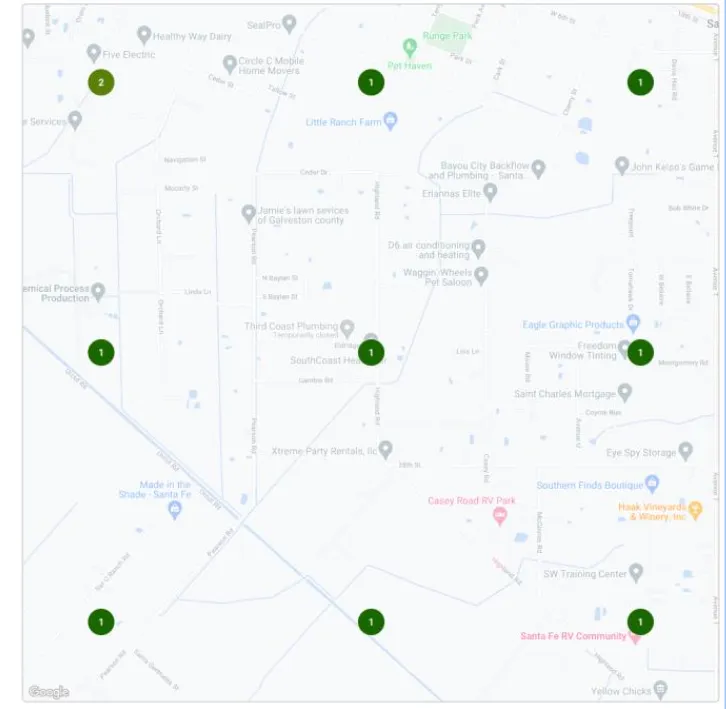
Each dot is a search from that spot. He was #1 at 8 of the 9 points and #2 at the other. The same day, he averaged position 1.44 for “AC repair” and for “AC installation”, and 1.78 for “air duct cleaning service”. Read a grid like a weather map. Green near your shop is the baseline. The work is turning the edges green.
Fix Your Primary Category First
Your primary category is the most important setting on your whole profile. It’s #1 in Whitespark’s 2026 survey, ahead of proximity and reviews. It’s also the most common mistake I see when I open a contractor’s profile.
Google’s rule is to pick as few categories as you can, as specific as you can, and to finish the sentence “this business IS a” rather than “this business HAS a.” For HVAC that usually means one of these as your primary:
- HVAC contractor
- Air conditioning contractor
- Heating contractor
- Air conditioning repair service
- Furnace repair service
Pick the one that matches the search you most want to win. Then add secondary categories only for work you do. You get up to 9 extra, and they rank #8 on the expert list.
HVAC has a trick most trades don’t. Switch your primary category with the season: “Air conditioning contractor” in the summer, “Heating contractor” in the winter. It makes sense to capitalize on the season.
How much does the category matter? A home builder I worked with had their primary category set to plain “Contractor.” I changed it to “Custom home builder,” built out the rest of the profile, and they got into the top 3. They closed two home builds from it, worth roughly $400,000 to $500,000 each. Different trade, same lesson. Google can’t show you for a search it doesn’t think you belong in.
Finish the Rest of Your Google Business Profile
After the category, fill in everything else: your services, your hours, your service area and real photos. It’s boring, and it works.
Hours. “Open at the time of search” is the #5 factor on the expert list. Set your holiday hours so you don’t show as closed when the AC dies on July 4th. Only list 24/7 if somebody answers at 2am.
Address. If customers don’t come to your shop, Google says you should hide your address and set a service area instead. The catch is that a visible address ranks better. It’s #7 on the expert list. So if you have a real shop or office customers can walk into, show it. If you work out of your house, hide it and live with that tradeoff. What you never do is rent a virtual office or a mailbox to get a better address. Google says those aren’t eligible for a profile at all.
Service area. Keep it within about 2 hours’ drive of where you’re based. That’s Google’s line. In practice you’ll rank much closer to home than that anyway.
Q&A. If someone tells you to load up your Q&A section, that advice is out of date. Google removed Q&A from Maps starting in December 2025 and replaced it with AI answers that pull from your profile and your reviews. The best thing you can do for those answers is keep your profile accurate.
Your Business Name: What Google Says vs. What the Data Shows
Google’s rule is simple. Your business name on the profile has to be your real-world name, with nothing extra added. Putting service or location words in the name can get the profile suspended.
The data says something different. Keywords in the business name are the #3 factor in the expert survey. Whitespark also looked at more than 1.4 million listings in 2026 and found names with keywords in them showed up in the top 3 more often in most industries.
Both things are true. Stuffing “Best AC Repair Houston” onto your profile breaks the rules, and Google can strip those words out and take the ranking boost with them. The legit route is a real name change. If you’re rebranding or filing a DBA anyway, putting “Heating & Air” in it is fair game.
Would I tell an HVAC owner to do it? It does help. But I’m seeing profiles get harder to verify, and that’s the risk you take on. It’s a risk versus reward call, and it comes down to your market and how stiff the competition is.
Reviews: What Moves Rankings and Calls
You want a high star rating and a steady flow of reviews with real text in them. Google says more reviews and better ratings can help your ranking, and the expert list has rating at #6 and review count at #9.
Reviews count for even more when people decide who to call. BrightLocal’s 2026 survey of 1,002 U.S. consumers found 97% read reviews for local businesses. 31% said they’ll only use a business with 4.5 stars or better, up from 17% the year before.
To be fair about the HVAC contractor’s results: he already had 320 reviews and a 4.9 rating before I started. That’s a big part of why the fixes worked so fast. If you’re sitting at 20 reviews, this is the first thing to work on.
The process I give HVAC owners:
- The tech asks on the spot. When the job’s done and the customer is happy, that’s the moment.
- Text a follow-up 24 hours later if they didn’t leave one then. Send the direct review link so it’s one tap.
- Reward your techs for every review. It keeps them asking.
Reward the tech, never the customer. Google removes reviews that were paid for or given in exchange for a discount. It also bans only asking your happy customers and pressuring people into leaving one. Ask everybody, the same way, every time.
Then reply to every review, good and bad. 89% of consumers expect an owner to respond. Keep it short and use their name.
Make Your Website Back Up the Profile
Your profile tells Google what you are. Your website has to agree with it.
For the HVAC contractor, the website work was simple. I reworked the home page around the main money search and added internal links with plain, direct anchor text pointing at it. It’s the same pattern I’ve used everywhere, including when I got a law firm to #1 for “Orange County personal injury lawyer,” one of the most competitive legal searches in California.
The setup I’d build for an HVAC shop:
- One page per main service. AC repair, AC installation, furnace repair, heat pumps, duct cleaning. Each one with the service and your area in the title and the first heading.
- Link to them from your strongest pages. Your home page and whatever pages get the most traffic and links. Use plain anchor text like “AC repair,” not “click here.”
- Service area pages for the towns you serve. Each one needs something true about that town: the neighborhoods you work in, the jobs you’ve done there, what’s different about the homes.
Don’t skip the town details. Copying one page across 30 cities and swapping the town name is what Google calls doorway pages, and it’s against its spam rules. You’ll see agencies say each city page needs 1,500 unique words. That number shows up on agency blogs with no source behind it. Write what’s useful for someone in that town and stop.
One more thing about your website: make sure it’s yours. The domain, the hosting login and your Google Business Profile should all be in your name. That HVAC contractor learned that the expensive way.
Citations and Local Links
Get your business name, address and phone number exactly the same everywhere you’re listed, then earn a few local links.
Citations first. That means Google, Bing Places, Apple Business Connect, Yelp, Facebook and the BBB, plus the trade directories. I’d also list on Angi and Thumbtack for the citation, but I’d put money into SEO and Google Ads before I’d pay for their leads. When I ran local SEO for 18 law firms, a lot of the work was this: auditing listings, fixing mismatches and getting duplicates cleaned up. It’s tedious, and it pays off.
Links next. You don’t need hundreds. The ones HVAC shops can get:
- The dealer locator on your equipment manufacturer’s site
- Your supply house, if they list contractors
- Local sponsorships: Little League, school events, the 5K
- Your chamber of commerce
If you want a bigger link, publish something local people want to cite. I once built a statistics page on dog bites for a personal injury firm. It earned links from 127 different websites. For HVAC, think local data: heat waves, the most common AC failures you see, what a new system really costs in your area.
What to Skip
A lot of local SEO advice is busywork. This is what I’d skip.
Posting on your profile to rank. It’s the most common “do this weekly” advice out there. In the expert survey, post frequency ranks 148th out of 187 factors. In my own testing I haven’t seen posts move rankings. They can help Google crawl your pages, and you can automate them, so they don’t hurt. Don’t pay someone to do them for rankings.
Seeding your Q&A. That feature’s gone.
Geo-tagged photos. Dead last in the survey, 187th of 187. Upload real photos of real jobs because they help people pick you, not because of what’s in the file data.
Cloned city pages and virtual offices. One is against Google’s spam rules, the other gets your profile pulled.
Agencies that need a year to show you anything. How long this takes depends on your market, your competition and where your site is now. My goal is always to find the low hanging fruit that gets leads in fastest. And I don’t do contracts. If someone isn’t happy working together, why keep going?
How to Tell It’s Working
Track two things: where you rank around your shop, and how many calls you get from it.
For rankings, run a grid scan like the one above once a month for your top 3 searches. That’s how I measured the HVAC contractor’s results. It shows you exactly where you’re green and where you’re not, which beats one rank number from a tool that searched from who knows where.
For calls, look at the calls and website clicks in your Google Business Profile, then count booked jobs. Rankings are a means to an end. Booked jobs are the number to watch.
If you do one thing this week, open your profile and check your primary category. Make sure it’s the most specific one that matches the search you most want to win. That’s where hyper local search starts: win the searches closest to your shop first, then push out. Then run one grid scan around your shop so you know where you’re starting from.
Frequently Asked Questions
How long does local SEO take for an HVAC company?
It depends on how big your market is, how strong the competition is, and where your site and profile are right now. The HVAC contractor in this guide was in the map pack within the first month after his rebuild. He also already had 320 reviews, which sped things up a lot.
How much does HVAC SEO cost?
It varies too much by market for one honest number. What matters more is what you get for it: work you can see every month, no long contract, and everything (your site, your domain, your profile) in your name.
Is local SEO still worth it in 2026?
Yes. Every big HVAC search, from “AC repair near me” to “furnace repair near me,” still shows a map pack. AI answers in Maps now pull from your profile and reviews too. The longer you wait to build that up, the harder it gets.
Should I change my Google Business Profile category for summer and winter?
For HVAC, yes. Run “Air conditioning contractor” as your primary in the summer and “Heating contractor” in the winter. Capitalize on the season.
Do Google Business Profile posts help rankings?
Not much. Post frequency ranks 148th of 187 factors in the 2026 expert survey, and I haven’t seen posts move rankings in my own testing. They’re low effort and don’t hurt, so automate them if you like.